
Juan Carlos Flores architect / arquitecto
project page
Casa Chachalaca
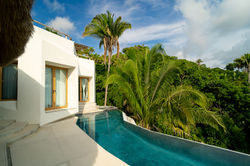
The house stands on the Mexican Pacific coast, perched on a hillside of tropical rainforest populated with papelillo (Bursera simaruba) and palm trees—the natural habitat of the chachalaca (Ortalis poliocephala).
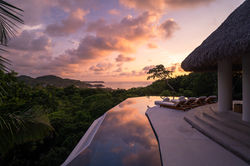
This is a place designed for connection with nature, where jungle, sea, and sky merge majestically on the horizon. The project needed to be worthy of this sanctuary. The serenity of the spaces invites an inner, contemplative stillness.
We believe that straight lines feel familiar to the human eye, while curves resonate more closely with nature. The fusion of both in this project creates a dialogue between the natural and the man-made, a bridge between architecture and the surrounding landscape.
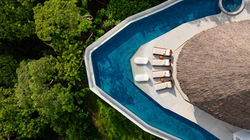
The geometric forms of the house were inspired by stones whose straight edges have been softened and rounded by millennia of wear. We imagined a stone falling at the center of the project, generating a shock wave radiating through the palapa, the terrace, and the perimeter pool.
We wanted the house to appear as if levitating among the treetops. Achieving this was a challenge: the site has a steep slope with a 25-meter drop from the access road to the lower level. The concrete structure supporting the pool and terrace platforms therefore became a defining feature of the project.
To preserve the project's sense of serenity, we selected a restrained palette of materials. Exterior walls are finished with a cement-and-sand plaster in an off-white tone. Interior walls are coated with polished white cement, creating a unique patina. Headboards, bed bases, and countertops in the bathrooms and kitchen are also crafted from polished white cement. Exterior floors are hammered white cement—a material ideal for outdoor living, cool under the sun and slip-resistant even in the rain. Interior floors are gray microcement. Shower walls, niches, and benches are finished in polished gray cement, while the floors combine rings of hammered white cement with bola stone. The palapa’s structure is built from guayabillo wood and topped with royal palm thatch. All finishes were handcrafted by Mexican artisans.
The house is entered through a portal that frames the sky and the reflecting water of a hand-carved marble fountain. Beyond it, a set of stairs functions as an open-air hallway connecting terraces, bedrooms, and social areas. The first covered space upon arrival is the study/TV room; descending further leads to the fire-pit platform and the daybed beneath a wooden pergola. The next platform brings you to the guest bedroom, accessed through a narrow, tall hallway for dramatic effect. The final platform arrives at the palapa and terrace. Behind the curved sofa’s low wall in the great room, open spaces serve as a vestibule, distributing circulation toward the master bedroom, kitchen, and guest bathroom.
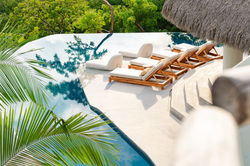
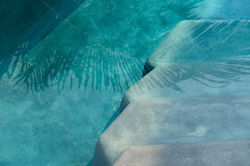
The palapa’s great room offers a panoramic view of the perimeter pool, the jungle, the sea, and the sky. The master bedroom is visually connected to the pool, and the master bathroom links directly to it via a staircase that descends to the cold plunge; the hot tub is positioned on the opposite side of the pool.
Beneath the large pool platform lie the cistern, mechanical rooms, the pool’s surge tank, and the maintenance staff quarters.
 |  |
|---|---|
 |  |
 |  |
 |  |
 |  |
 |  |
 |  |
 |  |
 |  |
 |  |
 |  |
 |  |
 |  |
 |  |
 |  |
 |  |
 |  |
 |  |
 |  |
 |  |
 |  |
 |  |
 |  |
 |  |
 |  |
 |  |
 |  |
 |  |